Attract More Students with Multilingual Business Listings
The phone rings, and a potential student enquires about the fee, says they'll consider it, and then never calls again. Another books a demonstration but doesn't turn up, and a third wants a weekend class you don't o...





The phone rings, and a potential student enquires about the fee, says they'll consider it, and then never calls again. Another books a demonstration but doesn't turn up, and a third wants a weekend class you don't offer.
By the end of the week, you will have answered dozens of questions even though you won't have filled the following batch.
For an individual trainer, this means less time is available for preparing lessons, while for an institute it involves spending money on marketing and admissions staff without having any idea as to why enquiries are not turning into enrolments.
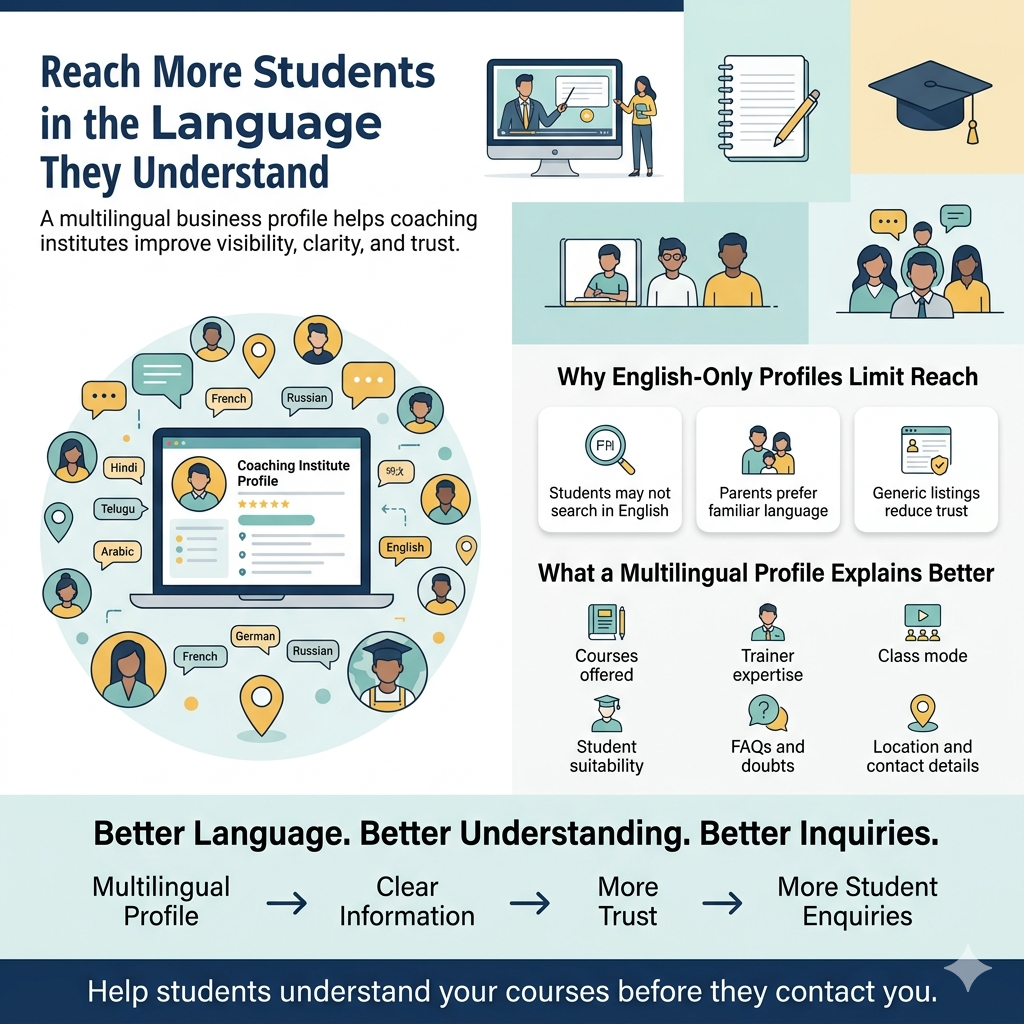
By including a multilingual business listing, you can present your courses to individuals who prefer to read in a language other than their own. The extent of this contribution depends on several factors: whether the course suits them, whether they understand the commitment involved, and whether your team replies to their questions.
The first step in reaching more students is to identify where these conversations fail.
Find out why interested students aren't joining.
Before increasing your promotional spending, review the inquiries you have recently received. Note the requested course, preferred language, inquiry source, schedule requirements, next steps, and outcome.
If a person declines, find out what the reason for their decision was; do not simply note 'fee issue' since they stopped responding after getting a quotation.
Different patterns point to different problems:
* A few questions. The right students might not be finding your courses.
* Many people ask the wrong questions. Your promotion might describe the audience or course too generally.
* It's possible that you have missed the demonstrations: the timings, the reminders, or the instructions on how to join may need to be checked.
* Look at the teaching, the expectations, the prices, and the follow-up without making any admissions.
* Regarding early withdrawals: make sure that the course is in keeping with what was promised to the students.
If working professionals repeatedly decline to enroll because classes begin before their workday ends, another advertisement will not fix the scheduling problem.
Select the first improvement based on what prospective students actually tell you.
2. Describe the kind of learner for whom your course is designed
The "English training for everyone" group includes people who require different types of teaching.
A beginner learning to construct sentences will struggle in a group that focuses on presentations, and a manager preparing for client meetings will lose interest in lessons based on basic grammar.
Describe each course around a recognizable learner and goal:
English for adults with basic knowledge of English who hesitate to have conversations in the workplace.
Explain the entry requirements, practice activities, schedule, and feedback.
When the starting level matters, conduct a short assessment before suggesting a batch; a suitable task can show more than simply asking whether people see themselves as beginners.
Explain when preparatory lessons are needed; although taking on an inappropriate student may fill a spot temporarily, it can disrupt the group, increase the need for support, and leave the learner feeling disappointed.
3. Select the languages from the inquiries which you are already receiving
Base your language choice on demand.
What language do the callers use when talking about fees? Do parents request explanations in Hindi? Are potential learners comfortable speaking English but less comfortable reading the detailed course terms?
Start with those patterns.
A Hindi profile would suit adults who speak Hindi and want to take English-speaking classes. An Arabic profile would suit Arabic-speaking learners who want the training you provide. Indian job seekers who intend to work in the Gulf do not automatically require an Arabic description.
Your profile should distinguish:
* The language employed in describing the course.
* The language employed in the lessons.
* The languages you can use for questions and support.
For instance, lessons are mostly conducted in English, and if the trainer needs to, they can explain unfamiliar concepts in Hindi.
Publish it only if it accurately reflects what happens in the classroom. The translation should not set expectations your teaching team cannot meet.
4. Provide students with the details that their parents will want to know.
Before making a payment, a prospective student might need to talk to a parent, a spouse, or an employer.
Create a course summary they can pass on without going into all the details. It should include the trainer's name, the syllabus, the course length, the schedule, the language used for teaching, the fee, and the support arrangements.
What practical requirements might influence the decision? For example, does the learner need a laptop? Will any software have to be paid for? Are exam registration fees separate? How much work should the students do between lessons?
For the online coding course, clearly state that a laptop is required for the practical assignments, and don't make this requirement appear only in the joining instructions.
Make sure the necessary information is easy to read on the listing or course page; although a brochure can provide more details, students should not need to download it to find the timings.
Make sure downloadable summaries include a revision date so outdated versions are easy to identify.
5. Deal with the objections about the fee by using an appropriate comparison.
If someone says another institute has a lower price, find out what is included in that course.
They may be comparing recorded videos with live instruction, a large-group course with one-on-one tutoring, or a brief introductory course with a longer program.
Explain your fee through the services delivered:
* The number and length of the live sessions.
* With a batch size that you keep at a stated level.
* Things to be assigned, evaluated, or have projects reviewed.
* Materials and recording access.
* Feedback on an individual basis and support on a scheduled basis.
* Fees for separate examination, software, or certification.
Instead of offering personal attention, the trainer reviews each submitted essay and provides written corrections.
If you offer installment payments, list the total amount due and the payment dates.
Some people cannot afford the course, and you should acknowledge this without pressuring them. If you have a more affordable option, make it clear how the services differ so they can choose with confidence.
6. Allow students to observe your method of teaching before they decide to enroll.
The qualifications give prospective learners information about your background, and a sample lesson lets them decide whether they can understand your explanations.
We could select one example of a teaching activity. For instance, a language trainer might show learners how to improve a typical answer to an interview question, while a programming trainer could point out a minor error and then help learners correct it.
Instead of showing only a finished product, show the process, along with explanation and practice.
You could also provide an anonymized version of an assignment, anonymous feedback, or a weekly practice plan. However, you must get permission before publishing any student work or any identifiable footage from the classroom.
When you mention students' achievements, include the relevant course name and provide some background information; otherwise, one student's exam result should not be interpreted as a guarantee for all students.
Describe certificates clearly; a certificate issued by your institute to show that a course has been completed differs from an independently assessed professional qualification.
7. Create demonstrations based on a practical learning task.
This should help both sides decide whether the course is suitable.
Before you book one, check the student's aims, estimated level, availability, and understanding of the fee; otherwise, you might end up spending half an hour teaching a student who can't attend any available classes.
Tell them what type of booking you want: either a regular class visit, a group sample lesson, or an individual assessment.
Send the date, duration, location or joining link, time zone (if applicable), and any required preparation; also include a simple way to reschedule.
While the session is going on, the learner should attempt something and get your feedback; a long talk about the institute doesn't much demonstrate how the lessons work.
Later, provide a specific recommendation: state which batch would suit them, what they should practice, or why a different starting level would be more appropriate.
8. Provide the answer that they are expecting
Students are unlikely to respond to repeated messages asking, "Are you interested?"
Note the unanswered question from the earlier conversation, since they might need a weekend timetable, want to find out about assignment support, or wish to talk to a parent about the fee.
Provide information in response to that concern.
A weekly timetable example may help someone concerned about their workload. A short extract from a lesson could help someone who is unsure about your teaching style. A precise batch schedule can address concerns about availability.
Set a suitable time for the next step and honor any requests to cease.
When you are teaching and messages are coming in, set a response time you can keep. You can use an automatic reply to indicate when someone will get a response.
Assign each inquiry to one staff member. Conflicting calls, duplicate messages, and different fee quotes make the institute harder to trust.
9. Verify if overseas students are actually able to take part
The fact that international inquiries arise means some practical questions cannot be answered with a translated description alone.
Can learners join the live sessions in their own time zone? Can they use the payment method that you offer? Will they get feedback in a language that they understand?
Publish the session times with the named time zone, and confirm the learner's local time for the relevant dates, especially during seasonal clock changes.
Make it clear what currency is used for payments, what payment methods are accepted, how to access the records, what equipment is required, and what will happen in the case of a missed session. Also state any extra charges which can be set beforehand.
If the listing is in a translated form but your admissions team only speaks English, state this and explain how you will handle written questions.
Start by focusing on one audience you can reliably support, and before moving into other language markets, test the process from initial inquiry through the first lesson.
10. Handle local and online discovery in a different way.
A physical institute needs accurate location information. Publish the correct address, map location, opening hours, entrance details, and transport information.
When you have multiple branches, ensure inquiries reach someone who knows the courses and schedule for that branch.
Google states that local search results are mainly based on relevance, distance, and prominence; although complete business information helps it understand the service, a directory listing cannot overcome the distance between an institute and the searcher.
Under Google's eligibility criteria, businesses that operate online are not allowed to have a Google Business Profile. Instead, online trainers should increase visibility through course pages, relevant directories, teaching content, and referrals, and should not create a physical location.
Accurately reflect your online availability, and do not promote classroom training in any city where you do not have teaching facilities.
11. Ensure that multilingual content is accessible to search engines
Translating a page doesn't mean every language version will be discoverable.
Google suggests that separate URLs should be used for the various language versions and for the language annotations, a method known as hreflang, in order to link the relevant pages. Google determines a page's language based on the visible content. Simply translating the menu while keeping the course description unchanged does not result in a fully translated page.
Ask your developer to verify that the language versions are accessible to search engines and linked via a functional language selector. On a listing platform, find out how it publishes language-specific profiles.
Use descriptive titles, for example “Online Python Training for Beginners”, and include a location if it is relevant to the service.
Have a fluent reviewer check the course's meaning and terminology.
While multilingual content can aid discovery, Google cannot guarantee that it will crawl, index, or include every page in the search results.
12. Commit yourself only to the kind of support that your schedule permits
It can be difficult to provide unlimited doubt support when a single trainer manages multiple batches.
Decide how you'll handle questions before promoting the service. Tell learners where to submit them, when replies are normally available, and which issues need a. To estimate the work involved in giving individual feedback, note that it takes five hours to review 30 assignments if each takes ten minutes, apart from the time spent teaching and preparing. If you can't manage that much time, modify the batch size, the number of staff members, the review format, or the promise. i.e., you also need to explain the catch-up arrangements; while a recording lets someone review a lesson, it does not replace every discussion or practical activity they miss. The students should be told what to do when they are absent, and it should also be stated whether additional sessions are more expensive; having specific arrangements enables learners to plan their activities and helps protect trainers from having to meet commitments which they are not able to keep consistently.t Look into any early difficulties before students decide to withdraw.
A person learning the subject may be full of enthusiasm but still have difficulties during the first week.
Check whether they can access the materials, understand the teaching language, complete assignments, and manage the expected study time.
Identify difficulties by using a simple early task. If a student gets it wrong, ask why; they might be confused, having technical trouble, or realizing the schedule doesn't work.
Explain terms on cancellation, batch transfer, and refunds before payment, and keep them easy to access afterward; admissions staff should also provide this information.
When a person decides to withdraw, note the reason without trying to make them reconsider.
Frequent worries regarding the speed of progress, the lack of feedback, or an unexpected amount of work should lead to changes in the course. Simply changing the promotional language won't solve what students experience in class.
14. Count admissions. Do not just count inquiries.
A crowded inbox may mask a costly recruitment process.
Keep records of suitable inquiries, demonstration bookings, attendance, paid enrolments, early withdrawals, and acquisition spending by source.
Set up an inquiry consistently. For instance, the person meets the entry requirements, wants the course offered, and can attend one of the available batches.
Work out the number of people who attend the demonstrations by dividing the number of attendees by the number of bookings. Determine the conversion rate from demonstration to enrolment by dividing the number of paid enrolments by the number of attendees. Leave sufficient time for people to make their decision.
If a hypothetical campaign cost ₹12,000 and resulted in six paid enrolments, the advertising cost per enrolment would be ₹2,000; counseling, teaching, and other operating costs are in addition.
Alongside the source, record the preferred language. A language version that receives fewer messages might still attract more appropriate learners.
Don't conclude with just two or three inquiries; look at enough completed decisions before changing course.
15. When you are listing your position on Whitefirms.org, make it specific.
When preparing a profile for Whitefirms.org, decide which learner group or course it should explain first.
Describe who the training suits, what students will practice, who teaches, how sessions run, and what support is included. Choose an available listing language that matches the intended audience, while stating the teaching language separately.
Select supporting material that helps readers assess the course: a sample lesson, syllabus, real classroom photos, or answers to common admissions questions.
Check that your listing, website, brochure, and admissions team describe the same offer. Different fees or conflicting support promises create unnecessary doubt.
Finish with a specific action, such as “Request the syllabus and next batch schedule,” and make sure someone can fulfill it.
The profile introduces the course. Your response and teaching must deliver what that introduction promises.
A 30-day plan to put these changes into practice
Week one: Review where admissions are being lost. Examine recent inquiries and withdrawals. Identify the most frequent reason suitable learners do not join. Correct inaccurate fees, schedules, course descriptions, and contact details immediately.
Week two: Prepare the material students keep requesting. Create one complete course summary, a representative teaching sample, and answers to recurring questions. Translate for one audience with real demand, then arrange a fluent review.
Week three: Test the admissions process. Check inquiry links, assign response responsibilities, improve demonstration confirmations, and log unanswered questions. Ask someone unfamiliar with the institute to complete the process on a phone.
Week four: Review decisions, not activity alone. Compare suitable inquiries, attendance, enrolments, and early student concerns. Update information people still misunderstand and continue tracking decisions that take longer than a month.
Let the results determine your next move. If students understand the course but cannot attend, reconsider the schedule. If they attend demonstrations but hesitate, examine teaching fit and what the fee includes. If suitable learners rarely find you, expand promotion.
A multilingual business listing works best when it leads to a course the student can understand, attend, afford, and benefit from—and an institute prepared to deliver it.