Why Your Business Is Easy to Understand Offline but Confusing Online
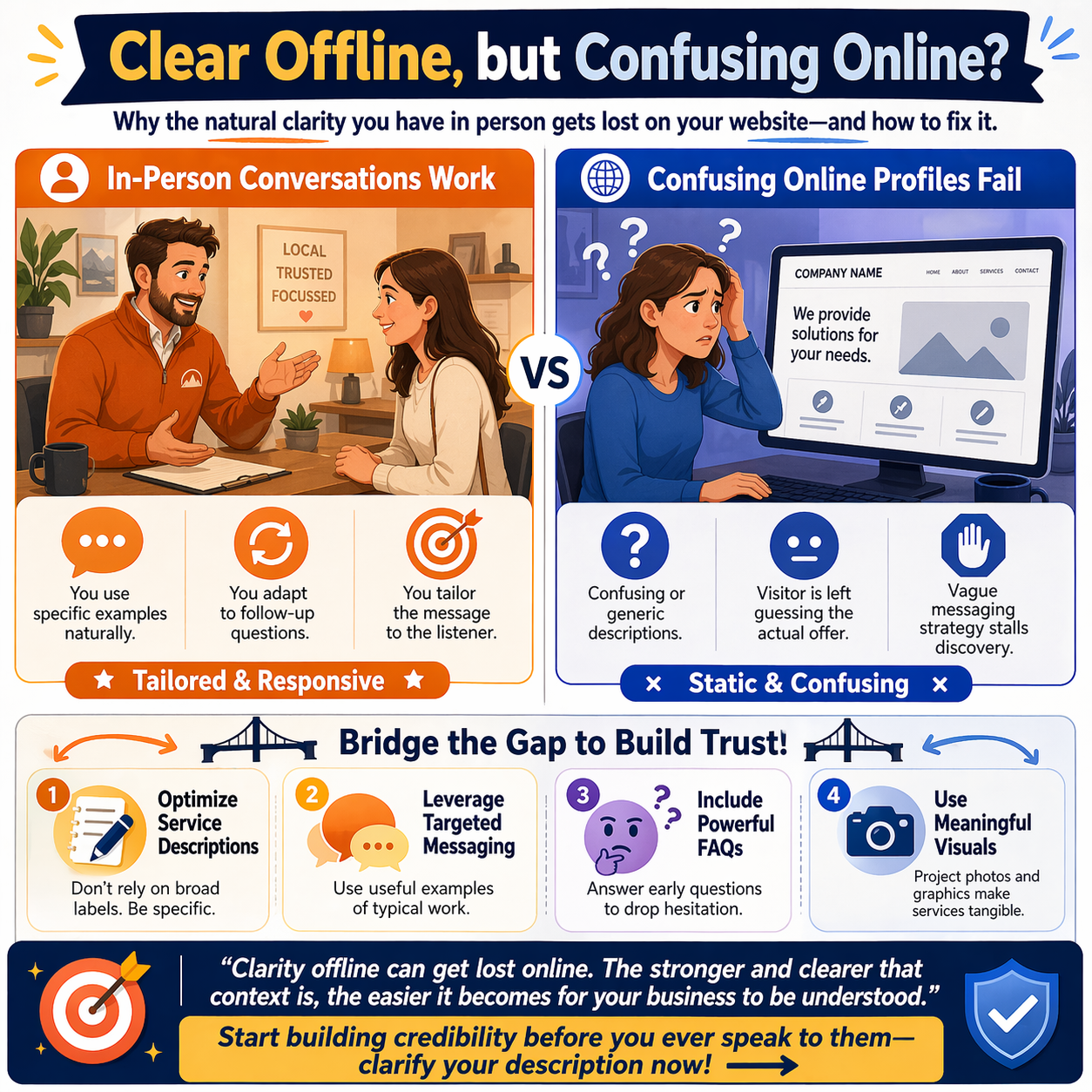
When a customer asks what you do, you explain the service, learn their requirements, and outline how the work will move forward; within a few minutes, they will know whether your business is a good match for them.No...





When a customer asks what you do, you explain the service, learn their requirements, and outline how the work will move forward; within a few minutes, they will know whether your business is a good match for them.
Now picture that person coming to your website after business hours.
The homepage claims to offer excellence, and the services page lists general categories, but the visitor still can't tell whether you actually meet their specific need.
Your experience is still there; the explanation is what's missing.
When talking to someone, you notice if there's any uncertainty and take account of it, but on the internet, customers have to rely on the information that you decide to publish; and if the details you normally give when speaking face to face are left out, even a competent business can become hard to evaluate.
The way to proceed is to lay out the usual explanations, organize them around customer decisions, and then see whether someone who knows nothing about your company can understand them.
Begin with the questions that you answer before a sale is made.
The content of your sales conversations is something a well-polished company introduction would easily miss.
When you consider the inquiries you've received, what did customers need to know before agreeing to move forward? Maybe they wanted to know whether installation was included, whether you took small orders, or whether you offered appointments outside normal working hours.
Review emails related to review inquiries, quotation requests, and notes from customer conversations to identify which explanations the people handling these inquiries repeat most often.
Separate the questions into three groups:
* Is this business able to meet my requirement?
* What factors influence the price, the timing, or the scope?
* What is the procedure I should follow in order to begin?
Plan your service pages using the answers and place the information where the question comes up. For example, include installation details next to the product or service description, rather than making them available only after a form has been submitted.
You don't need to give a lengthy answer to every question; sometimes a single sentence is enough to remove uncertainty.
Prepare a business description that someone could repeat verbatim.
Based on the opening description you provided, a customer should be able to state what your business does without using your slogans.
The phrase 'comprehensive business solutions' doesn't add much and may apply to an accountant, a software provider, or a management consultant.
A practical opening should name the work, mention the customer where appropriate, and state where or how the work is delivered.
Consider these illustrative rewrites:
* 'Professional training solutions' means 'Live online spreadsheet training for finance and administration teams'.
* Premium relocation services mean packing, transporting, and unpacking for moves from one apartment or office to another.
* "Quality industrial products" is equivalent to "conveyor belts, replacement rollers, and maintenance components for packaging lines".
The examples mentioned are not interchangeable; use only the details that match the services your business actually offers.
When your customers need it, keep specialist terminology; for example, a technically minded purchaser would expect to see material grades or the names of specific equipment. Instead of making the whole description vague, explain terms that less experienced readers may not know.
Once the offer is clear, explain why someone might choose you; your distinctive features should have a clear service to match.
Organize services around the customer’s task.
A website may have the correct information and yet be difficult to navigate.
Internal department names are usually a source of difficulty because they make sense to employees but offer little meaning to someone trying to arrange a repair, compare a course, or buy a component.
Navigation labels should reflect the user's needs; for example, 'Office cleaning' gives a visitor a more predictable destination than 'Workplace excellence'.
A catering company might have separate sections for weddings, office lunches, and private dinners because the questions involved differ, such as the number of guests, how the food will be served, menu options, and booking conditions.
Use separate pages when the offer or decision differs significantly; a small business offering a simple service will only need a single, well-organized page.
On every page, present the offer first, then explain its suitability, list inclusions, outline practical conditions, and explain the inquiry process. Use descriptive headings so readers can find the points most important to them without reading every paragraph.
Describe what customers get and when the service ends.
Just because you name a service doesn't mean you've defined its scope.
For instance, social media management might involve writing posts, designing images, scheduling content, responding to comments, or handling advertisements; a customer will not know which of these activities are included unless you explain them.
Outline the deliverables and state the major exclusions. Suppose photographic services cost extra; state that clearly. If a training course requires prior knowledge, specify what that knowledge is. If a maintenance contract does not include replacement parts, make this clear before anyone asks for the contract.
Depending on the business, buyers may also need:
* Where services can be obtained or the area over which deliveries are made.
* Minimum order or booking requirements.
* The expected turnaround time and the factors that can affect it.
* Materials, equipment, or documents they need to provide.
* The form of the final product.
Don't treat variable conditions as definite promises; if production time depends on quantity and material availability, explain that relationship.
A visitor who finds your service isn't up to standard still gets a clear answer; hiding the limitation only delays the disappointment.
Do not discuss pricing as if all jobs were the same.
A customer who enquires about the cost may just be trying to decide whether to continue the conversation.
If you can't give a fixed price, explain how you prepare a quotation. For example, a moving company could consider the collection and delivery locations, the amount of furniture and belongings, any access restrictions, and the packing requirements. Similarly, a photographer could prepare the quote based on coverage hours, travel time, and the agreed deliverables.
When you give a starting price, specify what it includes and explain when the total amount may change; otherwise, the price might lead people to expect the final quote to match it.
Tell customers what you need to work out the estimate: measurements, photographs, quantities, a consultation, or a site visit. Make it clear if the first assessment involves a fee.
This gives visitors a more practical option than asking them to contact you each time for individual details.
Give visitors something they can examine
The significance of any claims about reliability or experience increases when customers can examine the work in question.
Select material that addresses a buying question. Completing a project shows the kind of assignment you are willing to take on. A sample report can show the level of detail a client receives. Relevant qualifications can explain why a task falls within your area of expertise.
In the case of a brief study, you should explain the customer's requirements, the work that was carried out, and the documented result together with any dates or other context that are relevant to the way in which the result should be understood.
Do not assign fictitious figures to a genuine project. If confidentiality prevents disclosure, explain without naming the client or revealing any protected information.
New businesses may use labelled sample work, demonstrations, and relevant team experience. Make it clear how the individual experience differs from the projects the new company carries out.
Use photos and demos to answer specific questions.
Decide first what point you want someone to take away from the visual.
A photo of a completed kitchen shows the general outcome, while a more detailed view can illustrate storage arrangements or the materials used. When a manufacturer includes dimensions and a caption that names the model, the product photograph becomes more informative.
A demonstration can also focus on a specific point. For example, a tutor could show how an online lesson works, and a software provider could go through one task from start to finish.
Do not ask visitors to watch a video to get essential service information; make the main explanation available in text.
Offer captions for spoken video content, along with suitable transcripts or descriptions, so people who can't hear or see the media can get the important information. The W3C's accessibility guidelines also suggest text alternatives that communicate the information or function of significant images. W3C
Do not use stock photographs to represent your real staff, premises, or completed projects.
Make the inquiry process predictable.
Just because someone understands the service doesn't mean they understand what happens after they click the button.
The "Get started" option could result in a request for a quotation, a paid consultation, or an immediate purchase. Make sure the wording reflects the actual action.
The expectations for "Request a quotation", "Check lesson availability", and "Book a consultation" differ, and the page and destination should match those expectations.
Next to the form, state what information is needed and describe what happens after it's submitted. In the case of a hypothetical supplier, the instructions could be:
Please send us your product specifications and estimated quantity; our team will review the requirements and contact you about availability and quotation details.
Ask only for the information required at that stage; someone asking for a brochure might not be ready to fill in a detailed project questionnaire.
Try the process using a phone. Fill in the form, check the confirmation message, and make sure the inquiry reaches the right person.
Use FAQs for any other questions.
The FAQ section should cover any genuine uncertainty that remains after the main explanation.
Ask questions based on inquiries, support requests, and sales conversations; identify problems that repeatedly influence decisions, for example, whether customers can order samples, reschedule appointments, or arrange work outside normal hours.
Respond directly, then explain any conditions. Do not start each answer with a promotional statement about your commitment to service.
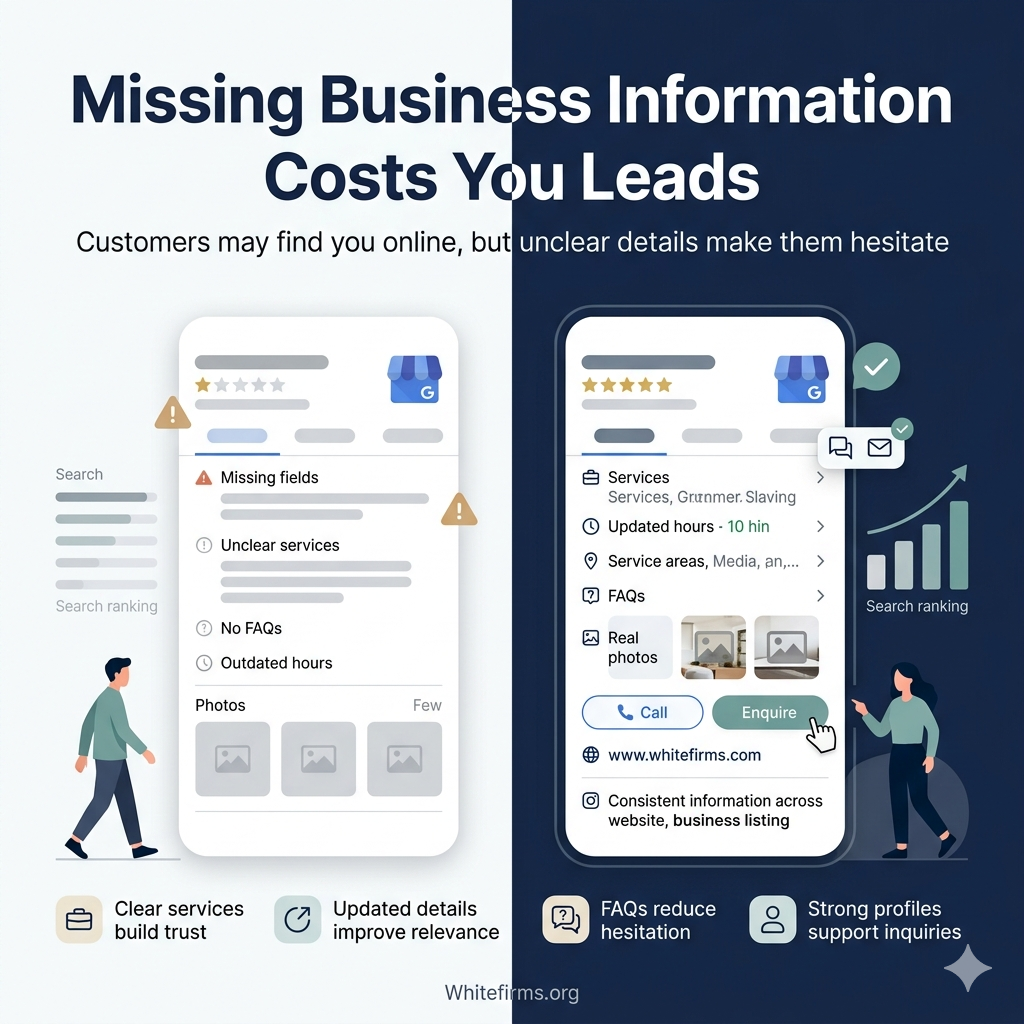
The main page should include all essential details so customers don't have to search the FAQ to find out what you sell or where you operate.
Also look for contradictions; for example, if the service page outlines one delivery method while an earlier FAQ describes a different one, the extra content only increases confusion.
Assign responsibility for updating these answers each time the offer changes. A short set of accurate responses is better than a long one no one keeps up with.
Make sure the offer is the same across all profiles and languages.
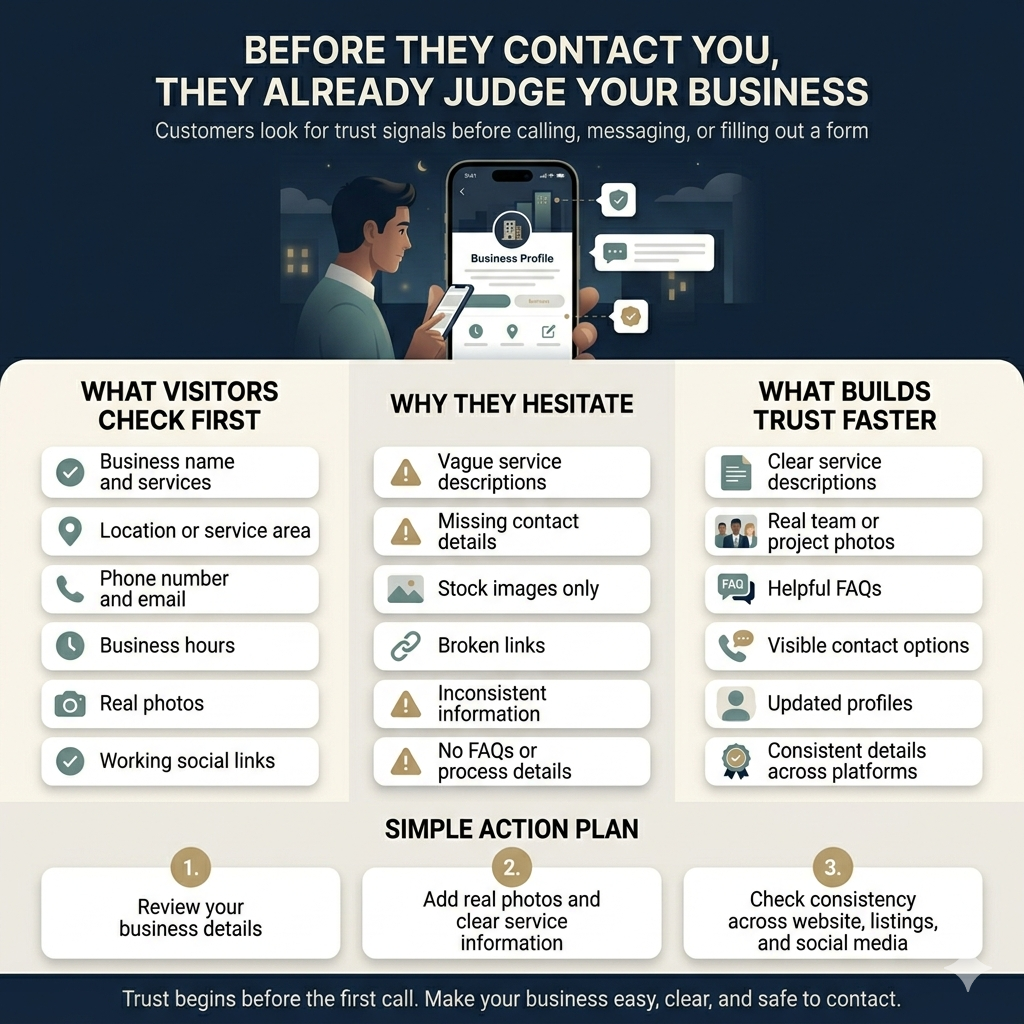
A person may see your directory listing or social profile before visiting your website, so the descriptions should present a consistent picture of your business.
It doesn't have to use the same words, but it must provide accurate information about services, addresses, contact details, and terms and conditions. A profile listing a service that is no longer available could generate inquiries, whereas your current website is intended to avoid them.
When addressing international audiences, review assumptions local customers might take for granted; specify state currencies, units of measurement, delivery destinations, and relevant time zones. Write dates in a format that prevents ambiguity.
Translation must include all information needed to evaluate and request the service; if the introduction is translated but the specifications or booking instructions are not accessible, the experience is incomplete.
Have someone who knows both the language and the subject review those pages. When you contact them, explain the language support available without suggesting that translation covers local delivery or support everywhere.
First, make the page easy to understand and then add more keywords.
You can combine customer language with proper search optimization.
The Google SEO Starter Guide suggests content should be easy to read and well organized, and it also advises considering the terms readers might use when searching. It adds that its systems can associate pages with different queries even when no exact wording variation appears. developers.google.com
In the page title and main heading, refer to the actual service. Add sections that address questions about whether the service is suitable, and link to related information when readers need it.
Don't replace a clear explanation with a series of search terms or lists of places you can't serve.
Expectations should be reasonable. More precise wording can clarify an offer, but that doesn't mean all visitors will ask questions or that a search engine will grant a specific ranking.
Test understanding with someone who could become a customer
Have a member of your target audience carry out an important page. Give them a realistic task, for example, checking whether you deal with the kind of project they have and finding out how to request a quotation.
Watch where they hesitate. Avoid explaining the page while they use it, because your explanation can interfere with their performance.UK suggests using realistic tasks, giving neutral instructions, and observing participants as they complete them. The objective is to identify problems with the service, language, or layout. GOV.UK problems with the service, language, or layout. GOV.UK
Afterward, ask the person to describe the offer in their own words. An incorrect answer reveals more than a general compliment about the design.
Update the confusing sections and repeat the exercise. Then monitor whether inquiries arrive with fewer misunderstandings about scope, price, or availability. Consider changes in traffic sources and seasonality before attributing results to the rewrite.
Start with one service your team explains well in conversation. Put that explanation on the page, check it with the person delivering the work, and let a prospective customer try it without assistance.