How Farmers Can Find Buyers Online and Prepare for Export
How Farmers Can Attract Buyers Online and Prepare Their Products for ExportA buyer from abroad suggests a price much higher than what you find in your local market, a pesticide dealer promises their product will mak...





How Farmers Can Attract Buyers Online and Prepare Their Products for Export
A buyer from abroad suggests a price much higher than what you find in your local market, a pesticide dealer promises their product will make your harvest export-ready, and an agent claims a certificate will bring international orders.
Before you spend any money, ask yourself three questions: Is it legal for your crop to enter that market? Can you meet the buyer's specifications? And how and when will you be paid? Asking these questions will enable you to decide whether the buyer's route is feasible before you proceed.
The quality of the produce and the appeal of the photographs make up only one part of the sale; buyers also need uniform grades, a reliable supply, suitable packaging, and records which they can inspect. Likewise, farmers need to know the buyer will be there, the offered price will cover their costs, and the transaction will not put the entire season's income at risk.
This guide is aimed at farmers, grower groups, cooperatives, and agricultural suppliers worldwide; however, specific rules vary depending on where you grow your crops, what you sell, and the shipment's destination.
Choose whether you want to export directly or if you want to supply an exporter.
You don't need to become an exporter to get your produce into an international supply chain; instead, decide which buyer route you'll take.
You can use an experienced exporter, work through a cooperative or producer organization, or handle overseas sales yourself. Each arrangement involves different responsibilities and levels of control.
If you supply an exporter, agree on the following:
* Variety, grade, size, and quality needs.
* The requirements relating to crop protection and recordkeeping.
* Who is responsible for arranging the sampling, testing, and collection?
* The amount of the produce is weighed, and then any that are rejected are recorded.
* At the time when ownership changes and the payment is required.
* Who will suffer the losses if the shipment overseas is rejected?
With direct exporting, you must verify the buyer, provide the necessary documentation, arrange freight, handle customs procedures, and collect payment. This also means more of the selling process falls on you.
A cooperative or experienced exporter can give small farms access to packing facilities and shared shipment quantities. Before opting for that method of selling, it is necessary to check the buyer's trading record and talk to the farmers who it has previously paid.
2. Make sure you have access to the market before expanding in order to meet an overseas request
Just because a crop is popular overseas doesn't mean every country that produces it can meet demand.
Import requirements can vary by crop type, country of origin, pest status, intended use, and processing method. Because different conditions apply to fresh fruit, dried fruit, seeds, and processed products, you must ensure the correct requirement applies to the specific shipment.
USDA APHIS provides commodity-specific plant import requirements for the United States through its Agricultural Commodity Import Requirements database. Instead of assuming that because another supplier can obtain the necessary access, you can too, check the exact product and country of origin.
Ask your national plant protection authority and the appropriate authority at the destination whether the shipment requires permits, is restricted to registered places of production, must be carried out in approved facilities, involves any treatments, or needs further declarations.
Don't forget to check export restrictions in your own country as well.
Before you decide to plant the goods, package them, or arrange for freight, make sure you have confirmed the government import and export rules, since a buyer's purchase order does not take precedence over those rules.
3. Learn what GAP certification entails and what it does not entail
Good Agricultural Practices include methods used to produce and handle crops, such as hygiene, crop protection, worker safety, and recordkeeping.
However, a single GAP certificate does not authorize exports to both the European Union and the United States.
GLOBALG.A.P. is a farm certification scheme commonly required by various supply chains as a condition for sourcing. It can help producers meet buyer procurement conditions, but it does not replace the destination country's import rules or guarantee access to that market.
Before you pay for certification, ask the buyer for the exact scheme, version, scope, and any other requirements. This will clarify what the buyer's path actually entails.
Make sure the certification body is approved for that scheme, and check which farms, crops, activities, and validity dates the certificate includes so the buyer's path matches the certificate.
Group certification is available to organized producers, provided the scheme allows it; however, it still requires proper records and management, not just a shared certificate.
You might qualify as a supplier through certification, but it doesn't ensure you will receive orders or a higher selling price, so don't treat it as the buyer's route.
4. Divide phytosanitary certification from food safety testing
These documents answer different questions.
A phytosanitary certificate shows that the relevant plant health requirements of the importing country, especially regarding regulated pests, have been met, and it is issued by the exporting country's national plant protection organization or an authority acting on its behalf.
A report on pesticide residues checks the amounts of certain residues in a sample of the batch; other laboratory tests may look at microorganisms, mycotoxins, heavy metals, or the product's characteristics.
A phytosanitary certificate does not replace pesticide residue testing, nor can it certify all aspects of food safety and commercial quality; separate these requirements and verify what each document includes.
Ask the plant protection authority what inspections, tests, or treatments apply to your shipment, and don't pay for a general "Phytosanitary package" without clear details.
Fumigation, irradiation, or heat treatment must be carried out on a case-by-case basis, depending on the product type and destination. Arrange them only when necessary or suitable, and only through authorized providers.
5. Plan how you will use pesticides for the target market before harvest.
A crop for which a pesticide is allowed in your country could still cause problems in an export market.
The destination may set its own maximum residue level, or MRL, the legal limit for a specific pesticide residue in a certain food. Since the EU applies its MRLs to both food produced within the Union and food that is imported, it is important to check the target market specifically.
Ask a qualified crop adviser to review your spray program against the following:
* Local pesticide approvals and label instructions.
* The destination’s residue requirements.
* Specifications for the buying party in written form additionally.
* The time at which the application is made and the date on which the harvest is planned.
The pre-harvest interval is the time that must elapse between the final application and harvesting, in accordance with the relevant instructions. Obey the label and follow professional advice; do not reduce this interval just because a buyer wants an earlier shipment.
Keep records of the applications. Do not assume washing the produce will make a non-compliant batch acceptable; keep records so you can trace what was used.
6. Take on the sellers of pesticides who promise to secure export orders
A pesticide seller can't guarantee that your crop will meet the requirements of each importing country.
Verify assertions like 'zero residue', 'export approved', or 'safe for every crop' by referring to the actual product authorization, permitted uses, and relevant supporting documentation.
Purchase the product through authorized channels and keep the invoice, batch number, original label, and application records, and avoid unlabelled mixtures, tampered packaging, and products whose origin you cannot verify.
The FAO regards illegal and fake pesticides as an issue that needs stronger regulation and enforcement, noting that appearance alone is not a reliable way to verify authenticity.
If you think a product is fake, stop using it and seek advice from your pesticide regulator or agricultural extension office. Keep the packaging and your purchase records safe.
Get independent advice before applying an unfamiliar product across the whole farm. Don't rely on the person selling an input as your only source. Test the specific batch and destination. Instead of saying "tested in a laboratory", specify the exact test, the particular lot, and the reporting requirements. Before you begin sampling, agree on the product, lot identification, substances or hazards to be tested, analytical limits, sampling method, and required report format.
Make sure the laboratory is competent to carry out those particular tests and is recognized in the relevant export program; since general accreditation does not imply that all possible tests are included, check the scope carefully.
Find out who is responsible for collecting the sample, since some programs require authorized sampling rather than the farmer simply sending a handful of their crops.
The report applies only to the sample and batch in question and does not automatically include later harvests, products from other farms, or mixed deliveries; therefore, it should not be regarded as general approval.
If a result does not meet a requirement, keep the entire batch and seek advice; do not mix it with other produce to dilute the issue. Make sure you've identified the cause before sending out another shipment.
8. Make records that link the shipment to the farm
Traceability is the ability to find out where a batch originated and what happened to it; therefore, you must keep records that link the shipment to the farm from beginning to end.
Start with a practical record system linking the following:
* Farmer and field identification.
* Crop and variety.
* Input applications.
* Harvest dates.
* Sampling and laboratory reports.
* Pack the dates and lot numbers.
* Quantities dispatched and recipients.
A notebook or spreadsheet will do at first, as long as the entries are consistent and easy to retrieve.
For cooperatives, you must collect and grade each member's lot to preserve its individual identity; otherwise, uncontrolled mixing would make it difficult to investigate a failed sample or a buyer complaint.
You must use the traceability systems required by your export program; for instance, India's APEDA runs HortiNet, a system used for certification and traceability for certain horticultural products. This system is specific to India and not a global registration requirement.
Instead, work out the amount you will retain, not just the quoted price.
At first glance, an export price may look attractive, but if you account for grading losses, testing, packing, transport, storage, freight, finance, and commissions, it doesn't look so good. Look at the full cost before you decide.
Work out returns based on the amount expected to be accepted for sale.
For instance, if you harvest 1,000 kilograms but only 700 meet the agreed grade, calculate export revenue on the 700 kilograms and assign a realistic market value to the rest.
Find out who covers the cost of inspection, destination handling, delays, rejected cartons, return freight, and disposal.
Find out whether the quoted price is the definite purchase price or an estimate in a consignment arrangement, where final payment depends on subsequent sales; this difference affects the buyer's journey and the risk you assume.
To compare the expected net return with domestic options, exporting should improve the economics of the sale, not just offer a higher headline price or involve the same risks.
10. Ensure quality is maintained after harvesting
A shipment may meet requirements at harvest but spoil before it reaches the buyer.
Before collection, agree on the matters relating to maturity, grading, packaging, cooling, storage, and transport. Since different crops have different temperature requirements, colder does not necessarily mean better.
Ask the packhouse or post-harvest specialist about ventilation, carton strength, stacking, moisture control, and compatibility with other cargo.
Find out who monitors conditions during transport and who will receive the records.
Provide a photograph showing the packed cartons, the labels, and the loading conditions. Record the dates and lot numbers so you can link the images to the shipment.
For perishable goods, allow for possible delays. Where can the cargo be kept? Who can decide if a flight is canceled or if border inspections take longer?
Do not harvest a full co11. Independently check the buyers, exporters, and intermediaries. A professional website, registration document, or social media profile does not prove they will pay. Get the official business name, registration information, physical address, person in charge of purchases, and trade references. Verify this information through independent registries and by contacting them directly. When acting as a local exporter, check the relevant registration and talk to the farmers or suppliers you have recently traded with. Ask them when payment is made, what deductions are taken, and how order disputes are handled. Little discussion of the specifications.Asks for payment to be made to an unrelated agent before receiving the order. Requests payment to an unrelated agent before receiving an order.
* There is pressure to adopt a specific unknown 'certification company'.
* Bank details can change suddenly.
* Refusal to give business information that can be checked.
A warning sign should prompt an investigation, not serve as automatic proof of fraud.
Check altered payment instructions by referring to a contact you have previously established. Do not base your decision solely on the message that announces the change.
12. Agree on the terms regarding payment and rejection before the goods are dispatched
Record the grade, quantity, tolerances, inspection arrangements, delivery responsibilities, payment date, and the procedure for handling complaints.
Clarify when ownership and transportation risk pass, and agree on where quality is checked and what records must be provided to reject goods or make a deduction.
Ask your bank's trade finance department about payment terms suitable for the buyer and the transaction. Different kinds of payment methods—such as advance payment, letters of credit, documentary collections, and open-account sales—involve different levels of risk.
A letter of credit depends on meeting its documentary conditions, whereas documentary collection does not offer the same bank payment guarantee. Export credit insurance too has its own conditions and exclusions.
Make sure you understand any terms before shipping; also, keep the first transaction small so a payment issue doesn't put the whole farm business at risk.
13. Release the product details that buyers need.
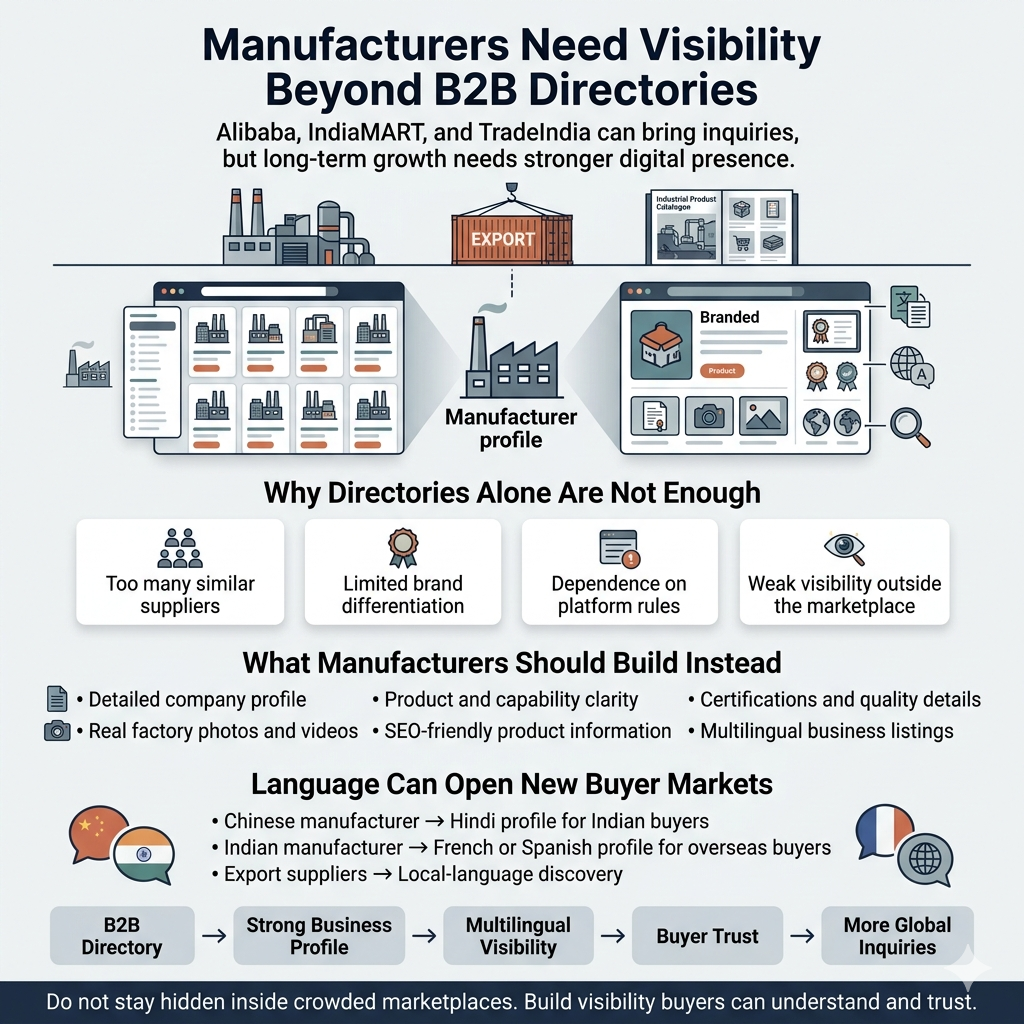
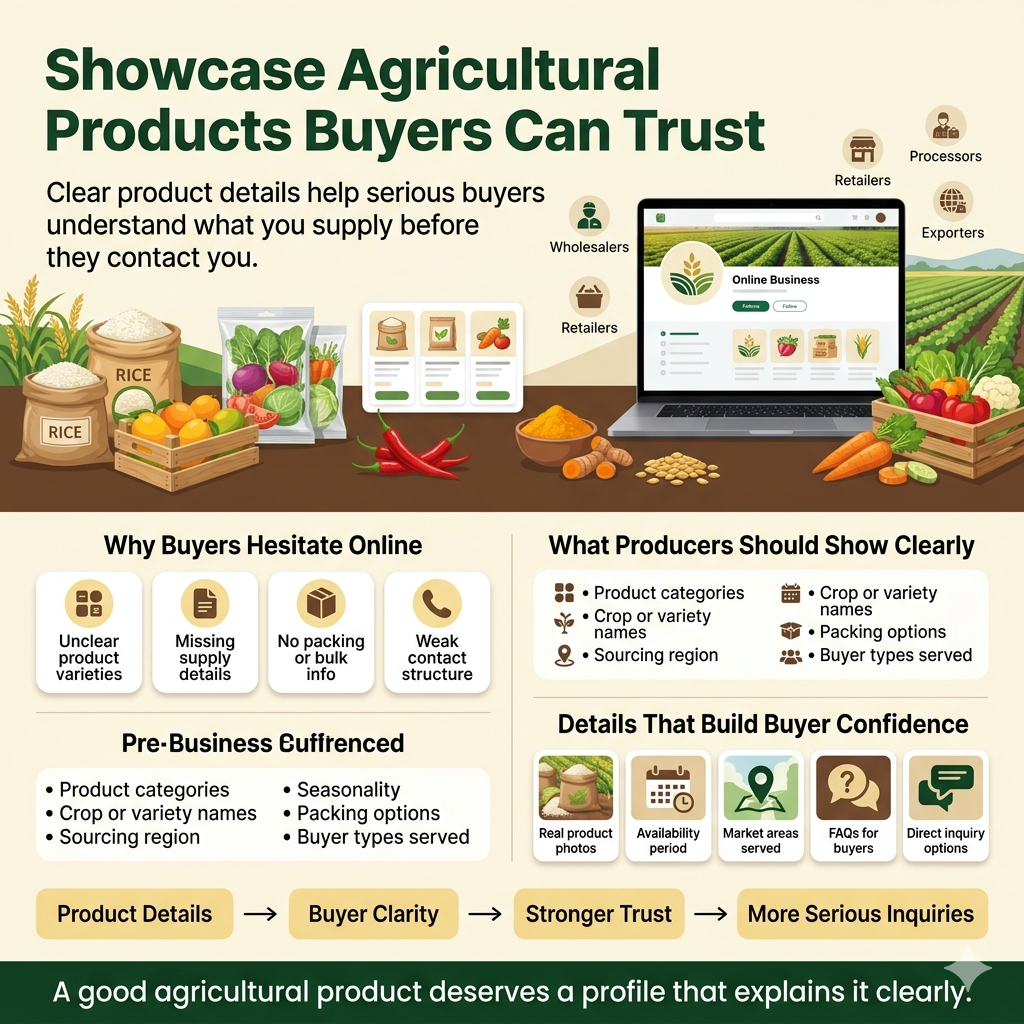
Your online profile must let buyers judge whether you can meet their requirements.
For every product, state the variety, growing region, harvest period, available form, grade or specification, packing options, order size, dispatch point, and realistic supply capacity.
Separate your own production from amounts obtained from other growers, and calculate the difference between estimated seasonal output and currently available stock.
Replace "premium turmeric" with real supply details: whether it is whole dried fingers or powder, its origin, packaging size, and tested properties where available.
For mangoes, state the variety, harvest period, grading, packing arrangements, and the markets you are currently willing to serve.
When preparing photographs of your produce and packaging, use recent ones, and avoid images that suggest facilities or quality you do not actually have.
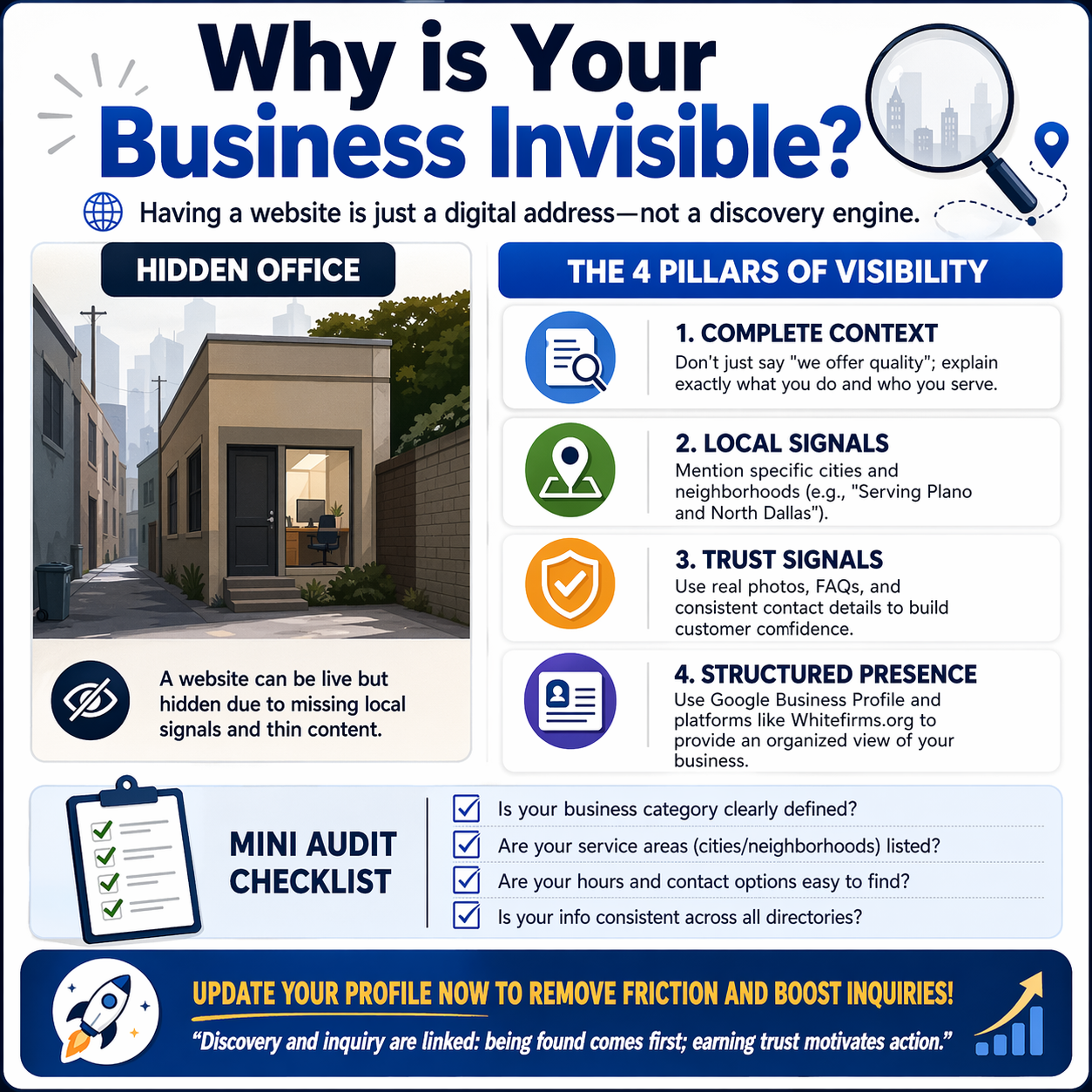
State certification scope accurately and share sensit14. Use listings in multiple languages to aid real buyer conversations. Supply translations for the markets you can serve, not just for languages with large audiences. Accurately preserve variety names, measurements, packaging specifications, certificate details, and commercial terms. Have someone familiar with the agricultural trade check the translation. Indicate the languages your team can use when taking inquiries. If you translate the description, it should not lead buyers to expect a telephone service you do not offer. When writing a profile for Whitefirms.org, arrange the information by product, origin, availability, supply arrangements, and documents you can provide as proof. Product, origin, availability, supply arrangements, and documents you can provide as proof.
Inquire with the following request: “Send us the variety that you require, the quantity, the destination, the packing format, and the delivery period.”
An online listing may introduce a supplier, but it doesn't replace buyer checks, certification, regulatory approval, or payment protection.
Know which organization to contact.
Worldwide farmers should start by contacting the organizations responsible for their crops and their location.
To learn about plant health and phytosanitary requirements, contact your national plant protection organization. The IPPC country directory lists the national contacts. These organizations can then guide you to the relevant inspection and certification office.
If you have problems related to crop management and suspicious inputs, contact your local agricultural extension service, the agriculture ministry, the public agricultural university, or the pesticide regulator. Be sure to bring the labels, invoices, application records, and photographs.
If you want to conduct market research and learn about standards, contact your national export promotion agency. The International Trade Centre offers tools such as the Market Access Map and the Standards Map to help you research market conditions and standards. You should also check with the competent authorities to confirm shipment requirements.
For EU destinations: refer to the food safety resources provided by the European Commission and to the authorities of the destination country. Make sure you check the current requirements regarding pesticides for the crop and the substances in question.
For information about plant health conditions, refer to USDA APHIS, and for the relevant food import requirements refer to FDA. Covered importers have foreign supplier verification obligations, provided these obligations fall within the scope of the rule and account for the exemptions.
Additional support for farmers in India
APEDA: Ask about requirements and advisories for APEDA-covered products, relevant traceability systems, and applicable laboratory or facility recognition.
DGFT: Check exporter registration requirements, the product’s export policy, restrictions, and applicable authorizations.
MANAGE, Hyderabad: Ask about relevant training and capacity-building programs for agricultural entrepreneurs, producer organizations, and extension personnel. MANAGE is a training institution, not a shipment approval authority.
Plant Quarantine authorities: Contact the appropriate station for export inspections and phytosanitary procedures.
Krishi Vigyan Kendras, state agriculture departments, and district horticulture offices: Seek local crop advice and ask about available training, registration support, and post-harvest facilities. Program eligibility varies; confirm it before investing.
Wherever you farm, approach the relevant office with a specific question: “I grow this crop in this region and want to supply this destination. What must I complete before harvest and dispatch?”
Before accepting your first export order
Confirm market access, obtain written specifications, verify the buyer, calculate the full cost, arrange testing and logistics, and agree on payment.
Keep a domestic outlet for produce that doesn't meet export grade but remains suitable and lawful for that market. Never treat an export rejection as automatic permission to sell elsewhere.
Start with a manageable shipment and review what happened: accepted quantity, deductions, arrival condition, payment timing, and actual profit.
The best starting point is a crop you can supply consistently, a buyer you have vetted, and a transaction whose requirements and costs you understand.